


What Are No-See-Ums
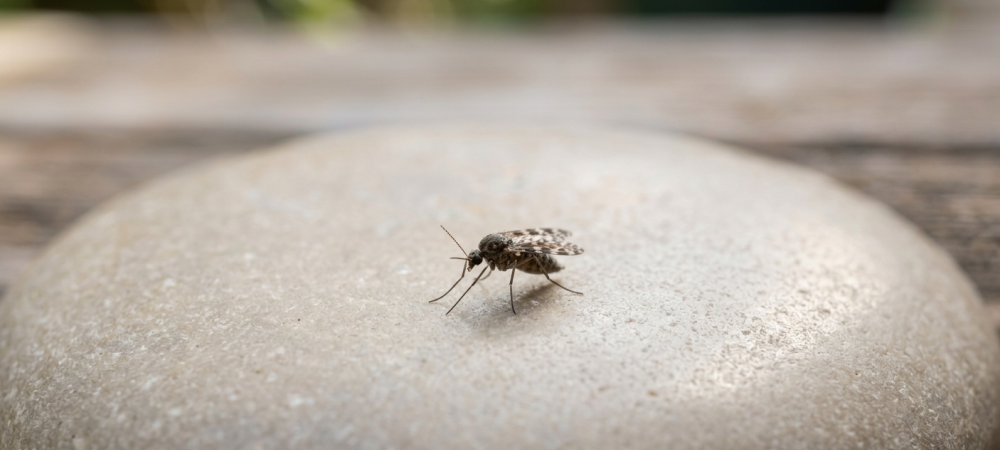
If you've spent any time outdoors along the Carolina coast at dusk, you know the feeling. An invisible swarm of something biting every inch of exposed skin, leaving behind welts that itch far worse than a mosquito bite. You look around and can't see a thing. That's a no-see-um, and if you live near the water here, they're a seasonal reality that most repellents and screens aren't equipped to handle.
Quick answer: No-see-ums are biting midges, tiny blood-sucking flies in the genus Culicoides that breed in the coastal salt marshes, mud flats, and wet soil that define the Carolina coast. According to NC State Extension, they are present throughout most of the warm weather season in coastal North Carolina, and are significantly harder to control than mosquitoes because their larvae develop in mud rather than standing water, making the source of the problem largely inaccessible.
What No-See-Ums Actually Are
No-see-ums are biting midges, not gnats, mosquitoes, or sand fleas, though they go by all of those names depending on where you are. The scientific genus is Culicoides, and NC State Extension documents multiple species active along the North Carolina coast. They are true flies, going through a complete life cycle of egg, larva, pupa, and adult.
Only female no-see-ums bite. Like female mosquitoes, they need the protein in blood to develop their eggs. Males feed on plant nectar and are not a biting concern. A single female can lay several batches of eggs across her lifespan, with each batch containing up to 400 eggs that hatch in as little as 10 days under ideal coastal conditions.
What Do No-See-Ums Look Like?
Adult biting midges are sometimes only 0.5 mm long, which is smaller than the period at the end of this sentence. Their legs are unmarked or banded, and their wings are clear or lightly spotted. In practical terms, they are nearly impossible to see with the naked eye until they land, which is usually after the bite has already happened.
They are sometimes confused with fungus gnats or fruit flies, but the key difference is the bite. Fungus gnats and fruit flies don't bite. If something that small is biting you, it's almost certainly a no-see-um or a biting midge.
Why Coastal Carolina Has Such a Bad No-See-Um Problem
According to NC State Extension, no-see-ums are present along the North Carolina coast throughout most of the warm weather season, and the coastal geography is a large part of why. The Carolinas are named among the most no-see-um-affected coastal states in the country, alongside Florida, Georgia, and Texas.
The salt marshes, tidal mud flats, pluff mud, and brackish wetlands that run through this region are exactly what no-see-um larvae need to develop. They breed in densely shaded areas along the edges of grass marshes, in damp soil near freshwater, and in any wet organic material including decaying seaweed that washes up after storms. Coastal Carolina has an abundance of all of these, and it doesn't dry out enough between storms or tidal cycles to interrupt the breeding cycle the way a drier inland climate might.
When No-See-Um Activity Peaks
No-see-ums are most active during dawn and dusk, which is the same window when mosquito activity tends to peak. They are also more active on overcast days when UV levels are low, and conditions stay humid. Wind suppresses their activity significantly since they are too small and light to fly well in a breeze, which is why they tend to be worse on calm evenings.
Along the Coastal Carolina coast, NC State Extension notes that flies are usually present throughout most of the warm weather season, which runs from spring through fall. In mild years, activity can extend into November. Peak pressure typically runs from late spring through early fall, with the worst activity in the warm, calm, humid evenings of June through September.
No-See-Um Bites
No-see-um bites are disproportionately uncomfortable relative to the size of the insect. The initial bite is a sharp, burning sting. Within hours, the bite site develops into a small, raised, intensely itchy welt that can persist for several days, longer than a typical mosquito bite.
People react differently. Some develop only minor irritation, others experience significant swelling, and some develop a stronger delayed reaction that includes blistering or a larger raised area around the bite. Multiple bites, which is almost always what happens since no-see-ums swarm, can produce a rash-like pattern across exposed skin.
In terms of disease risk, the CDC notes that no-see-um species active in the United States are not known vectors of disease to humans, though they do carry bluetongue virus, which affects livestock. The discomfort is significant, but the health risk is limited to the bite reaction itself.
Where No-See-Ums Breed Around Your Property
Unlike mosquitoes, no-see-ums don't breed in standing water. Their larvae develop in wet, organic-rich mud and soil, which makes source reduction significantly harder for homeowners.
- Salt marsh edges and tidal areas adjacent to coastal properties are the primary breeding source and largely outside a homeowner's control.
- Damp soil under dense vegetation, particularly in shaded low-lying areas near the foundation, can support midge larvae.
- Storm debris and decaying organic material along the property line, including leaves, mulch, and seaweed washed in by a storm, are active breeding areas.
- Low spots in the yard that stay consistently damp after rain create the moist soil conditions larvae need.
How to Get Rid of No-See-Ums
NC State Extension is direct on this point: controlling immature biting midges is not practical in North Carolina. Chemical controls are only temporarily effective against adults because new midges rapidly move in from surrounding breeding areas after a treatment dissipates. That said, there are meaningful steps that reduce pressure and exposure.
- DEET-based repellents are the most effective personal protection against no-see-ums. Products with 20 to 30 percent DEET applied to exposed skin provide the best defense during peak activity hours.
- Reduce damp, shaded areas near the home. Clearing storm debris, improving drainage in low spots, and pulling dense vegetation away from the foundation reduces the amount of suitable breeding habitat directly around the structure.
- Outdoor fans on decks and porches create enough airflow to disrupt no-see-um flight. Since they are too small and light to fly well in wind, even a moderate breeze from a fan significantly reduces activity in a contained outdoor area.
- Avoid peak activity hours when possible. Dawn and dusk on calm, humid evenings are the highest-exposure windows. Scheduling outdoor activity for midday or when there's a natural breeze reduces bite pressure without any treatment.
- Professional perimeter treatments targeting adult midges can provide short-term relief, particularly before an outdoor event. The effect is temporary given the volume of breeding habitat nearby, but a well-timed treatment meaningfully reduces the adult population on the property.
Why Standard Mosquito Screens Don't Stop No-See-Ums
Standard window and door screens are designed to keep out mosquitoes, which are large enough that a mesh with 16 openings per inch provides adequate protection. No-see-ums are small enough to pass through standard mesh entirely.
Midges can find gaps or tears in standard screens that allow them to enter homes even when the screens appear intact. Screens rated specifically for no-see-ums use a finer mesh, sometimes 20 by 20 openings per inch or smaller, that blocks midges but also reduces airflow significantly. For properties near marsh or heavy breeding areas, these screens can make a real difference for enclosed porches and sleeping areas.